What is Concern Alignment?
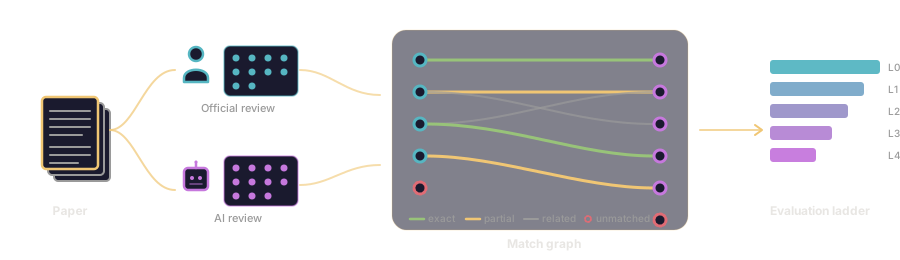
Concern alignment is an evaluation substrate, a diagnostic framework for auditing AI peer review systems at the concern level rather than relying on binary accept/reject accuracy.
When an AI reviewer achieves 50% accuracy, what does that actually mean? Does it reject everything and benefit from a balanced test set? Does it find real issues but assign wrong severity? Does it hallucinate concerns with no basis in official reviews?
This framework answers these questions by decomposing review quality into five diagnostic levels (L0–L4), each revealing failure modes invisible to the level below.
Key Terminology
Official concern — A specific issue raised by human peer reviewers and/or the Area Chair (AC) in the official review process.
Agentic concern — A specific issue raised by the AI review system being evaluated.
Match — An explicit alignment between an official and agentic concern, indicating the AI identified a similar issue.
Phantom — An AI-generated concern with no strict match to any official concern. Not all phantoms are equal: many are legitimate concerns officials did not raise, while others are fabricated or over-severe.
Decisive blocker — A concern the AC explicitly identified as driving the rejection decision.
Release scope
This release combines two layers of evidence: the 48-paper calibration benchmark (864 match graphs, 670 official concerns, 79 decisive blockers) and the Named Papers public diagnostic slice (9 papers, 54 match graphs, 150 official concerns). Aggregate metrics on this site are benchmark-wide; the Named Papers section ships end-to-end raw artifacts for the public slice. See RELEASE_MANIFEST.md for the full surface contract.
Related work
The AAAI-26 AI Review Pilot (Biswas et al., 2026) studies AI as an assistive tool for human reviewers at conference scale. The framework here is complementary: it evaluates standalone AI reviewers at the concern level — six public systems head-to-head on 864 match graphs — rather than AI-as-assistance deployments. The two address different slices of the same question.
The Five-Level Evaluation Ladder
Each level reveals a failure mode invisible to the level below. The ladder is designed so that a system can appear competent at level N while being deeply flawed at level N+1.
L0 Binary Verdict Accuracy
Does the system get accept/reject right? This is the most common evaluation metric, but reveals almost nothing about review quality. A system that rejects everything achieves 50% on a balanced test set.
L1 Concern Detection
Does the system find the real issues? Measured via concern recall (fraction of official concerns matched by an AI concern) and phantom rate (fraction of AI concerns with no official basis). L1 is verdict-blind: it measures what the system sees, not how it decides.
L2 Verdict-Stratified Metrics
Is accuracy balanced or gaming the base rate? Splits Level 0–1 metrics (both accuracy and concern detection) by accepted versus rejected papers, revealing reject-everything behavior that overall accuracy hides.
L3 Decision-Aware Metrics
When the AI says "fatal flaw," is it right? Includes false decisive rate (FDR) on accepted papers, decisive precision and phantom decisive rate on rejected papers, and resolved-escalation rate. FDR measures how often the system flags concerns as decisive on papers the AC accepted. High FDR means the system over-escalates.
L4 Rebuttal-Aware Decomposition
Does the system focus on what actually drove the decision? Computes recall separately for each AC treatment category: decisive blocker, unresolved, accepted limitation, and resolved. The gap between decisive-blocker recall and resolved-concern recall reveals whether the system tracks what the AC actually cared about. Negative gaps indicate inverted attention.
Match Types & Alignment Labels
The match graph maps explicit alignments between official and AI concerns. Each edge carries three labels.
Match Type
exact
Same underlying issue, same scope. A fix by the authors would address both.
partial
Same issue family but different scope or sub-claim. Overlapping but not identical fixes.
related
Nearby topic but not the same issue. A near-miss; excluded from strict metrics (recall, phantom rate).
Judgment Alignment
aligned — Both treat it as a weakness/concern (same normative direction).
inverted — Same fact, opposite conclusion. The AI treats a non-blocking limitation as fatal, or a weakness as a feature.
mixed — Partially aligned, partially inverted. Rare; usually means the concern should be split.
Severity Alignment
match — Same severity level. Fatal requires an exact match; among non-fatal concerns, one-level gaps count as matches (e.g., major↔moderate).
under — Agentic severity lower than official. System too lenient on this concern.
over — Agentic severity higher than official. System too harsh on this concern.
The Five-Step Pipeline
Concern alignment evaluation follows a strict pipeline. Each step produces a structured YAML artifact conforming to the project schemas.
Step 1 — Extract Official Concerns
Input: OpenReview PDFs (reviews, rebuttal, and meta-review) + paper PDF. Output: structured YAML with all official reviewer concerns, severity, AC treatment, and decision drivers. Each concern is tagged with how the AC treated it: decisive_blocker, unresolved, resolved, accepted_limitation, etc.
Step 2 — Extract Agentic Concerns
Input: AI review output (text, JSON, structured summary). Output: structured YAML with AI concerns, verdict, decision drivers. Each concern includes severity (level + addressability + mechanism) and a decisive flag.
Step 3 — Build Match Graph
Input: Official + agentic concerns. Output: explicit bipartite edges with match type, judgment alignment, and severity alignment labels. This is the core step, distinguishing "did you see it?" from "did you understand it?" from "did you weight it correctly?"
Step 4 — Verify Edges
Input: match graph + source documents. An independent LLM re-judges each edge's match_type, judgment_alignment, and severity_alignment. Semantic verification ensures the match graph is defensible and not just a product of optimistic matching.
Step 5 — Aggregate Metrics
Input: 864 match graphs (6 configs × 48 papers × 3 runs). Output: per-system L0–L4 metrics with bootstrap confidence intervals. Includes error-type stratification, concern-type breakdowns, judgment inversion rates, and phantom analysis.
Verdict Terminology
Several terms about how we read an AI reviewer's verdict appear throughout the site. Because they're easy to confuse, this page defines them in one place.
AI review
The raw text output of a baseline AI reviewer on one paper. Free-form prose, not a structured field. Six configurations × 48 papers = 288 reviews on the main benchmark; six × 9 = 54 reviews on the public diagnostic slice.
Native verdict
A binary ACCEPT/REJECT field the AI reviewer emits as part of its structured output. System A (both Opus and GPT-4o configurations) emits a native Decision field — those two configurations are native-verdict. The other four configurations require the verdict to be inferred from the review text.
Extraction pipeline (or "the pipeline")
Step 2 of the Five-Step Pipeline above. For each AI review, a Claude Sonnet pass reads the review text and assigns an ACCEPT or REJECT verdict. When the review does not contain a clear recommendation, the rule is default-REJECT. This is the verdict we use for the website's headline tables, the paper's main-text numbers, and every case study's per-paper verdict column (unless noted otherwise).
Default-REJECT rule
The fallback rule inside the extraction pipeline: if the AI review does not express a clear acceptance signal, the extracted verdict is REJECT. This avoids false ACCEPTs on hedged or noncommittal reviews, but it can turn an unclear review into a REJECT even when an independent reader would read it as leaning ACCEPT.
Verdict-inference audit
An independent re-reading of the AI reviews using two alternative inference methods and two raters. Conducted after we noticed the pipeline's default-REJECT rule was likely shifting the reported verdict counts. The audit was run twice:
- 48-paper benchmark audit: all 288 reviews, three methods, two raters, 54 human-adjudicated cases. Documented in the paper appendix; the per-review CSV is not vendored in this public release.
- 9-paper Named Papers audit: all 54 reviews on the public slice, same design. The reconciled CSV is under
data/audit/; the Verdict Sensitivity panel is the interactive exploration.
Tone method
Alternative inference method: a separate LLM reads the raw review text without a default-REJECT rule and assigns ACCEPT / REJECT / AMBIGUOUS. Two raters apply this method independently: Rater 1 (Claude Opus) and Rater 2 (ChatGPT 5.4 Pro Extended Thinking, run through a batch package).
Gate method
Alternative inference method: each major or fatal concern is classified into gate categories (G0–G7). Deterministic rules then decide the verdict — any fatal concern is REJECT; two or more "fundamental" gate hits (G1/G2/G4/G5) is REJECT; zero hits plus a positive acceptance signal is ACCEPT; else AMBIGUOUS. Same two raters as the tone method.
UNRELIABLE
A label applied only to System M · GPT-4o reviews. This configuration emits multi-agent coordination artifacts (inter-agent messages, repeated draft fragments) that never resolve into a single coherent recommendation. No verdict inference method can reliably read an intended verdict from such a review, so its audited verdict is flagged UNRELIABLE regardless of which method is applied.
3-run mean vs single run
The website's homepage, the paper's main-text numbers, and the key-findings lists use 3-run means — each AI reviewer was run three independent times and the per-paper metrics averaged. The audit, the case studies' per-paper verdict tables, and the 48-paper benchmark table on comparison pages use single run (run 1) because re-running the audit on three runs was not cost-justified. When numbers do not match across surfaces, this is almost always why.
Pipeline verdict vs final verdict
In the audit CSVs (data/audit/), every review has both a pipeline_verdict column (what our extraction pipeline produced at release) and a final_verdict column (the resolved value combining pipeline, tone, gate, and human adjudication). The Verdict Sensitivity panel's matrix and drill-down show how often these diverge per configuration.
Schema Reference
All artifacts are defined by YAML schemas and structurally validated by rur lint. The schemas live in schemas/.
Official Concerns
concerns:
- id: O1
text: "Single evaluation tool used"
severity: fatal | major | moderate | minor
resolved_in_rebuttal: true | false | null
ac_treatment: decisive_blocker | unresolved | resolved | ...
decisive: true | false
tags: [evaluation, methodology]
Agentic Concerns
verdict: ACCEPT | REJECT
concerns:
- id: A1
text: "TRM never validated"
severity:
level: fatal | major | moderate | minor
addressability: unresolved | addressable
mechanism: "Why this is a problem" # optional
source: review_major | review_minor | gates | ... # required
decisive: true | false
tags: [validation, methodology]
Match Graph
matches:
- official_id: O1
agentic_id: A3
match_type: exact | partial | related
issue: "Canonical one-sentence issue" # required
judgment_alignment: aligned | inverted | mixed | n/a
severity_alignment: match | under | over | n/a
rationale: "Why this match"
unmatched_official: [O2, O5] # missed by AI
unmatched_agentic: [A7, A9] # phantoms